
Diesel Emissions Services
Mondak diagnoses the cause first, then decides whether the answer is repair, regeneration, cleaning, or a combination of them.
A Regen Isn't a Diagnosis
A derate, plugged DPF or failed regeneration tells you the emissions system has a problem.
It does not automatically tell you what caused it.
Sometimes the filter needs cleaning. Sometimes the EGR system is loaded with carbon. Sometimes a sensor, dosing system, turbo, engine problem or wiring fault is keeping the system from doing what it was designed to do.
Complete Diesel Aftertreatment Service
Mondak works across modern diesel emissions systems including:
- DPF: Diesel Particulate Filter
- DOC: Diesel Oxidation Catalyst
- SCR: Selective Catalytic Reduction
- DEF systems
- EGR valves and coolers
- VGT turbo systems
- NOx sensors
- Exhaust temperature sensors
- Differential-pressure sensors
- DEF pumps and supply modules
- DEF dosing valves
- Hydrocarbon dosers
- Aftertreatment controllers
- Wiring and communication
- Failed regeneration
- Frequent regeneration
- Derates and inducements
Mondak Is a Diesel Force Dealer
Mondak Equipment is a Diesel Force dealer with the full Diesel Force equipment system for servicing modern diesel engines and emissions systems.
That gives us another option between simply forcing another regen and replacing expensive emissions components.
Our Diesel Force equipment includes systems for small through large-displacement diesel engines, including:
- Diesel Force B1400
- Diesel Force B1500
- Diesel Force B1500-X
- Diesel Force Electronic Component Controller
- Engine-specific adapters and tooling
The B1400 is designed for engines up to approximately 9 liters, while the B1500 handles engines through 18 liters. The B1500-X is designed for larger and severe-duty applications where heavy carbon buildup is common.
Diesel Force gives us another tool to clean the system. Diagnostics tell us whether cleaning is actually the right repair.
Cleaning More Than the DPF
Carbon buildup does not begin at the end of the exhaust pipe.
The Diesel Force process can address deposits through areas including:
- EGR circuit
- EGR cooler
- EGR valve
- Intake and induction system
- Exhaust side of the VGT turbo
- DOC
- DPF
- Differential-pressure sensor ports
- Other applicable emissions passages
Diesel Force uses engine-specific adapters to deliver its cleaner through the EGR and induction/emissions circuit rather than treating the DPF as the only component that matters.
That matters when repeated DPF problems are really being driven by carbon buildup farther upstream.
EGR & VGT Cleaning With Electronic Control
Modern EGR valves and variable-geometry turbos may stay in limited positions while the engine is idling.
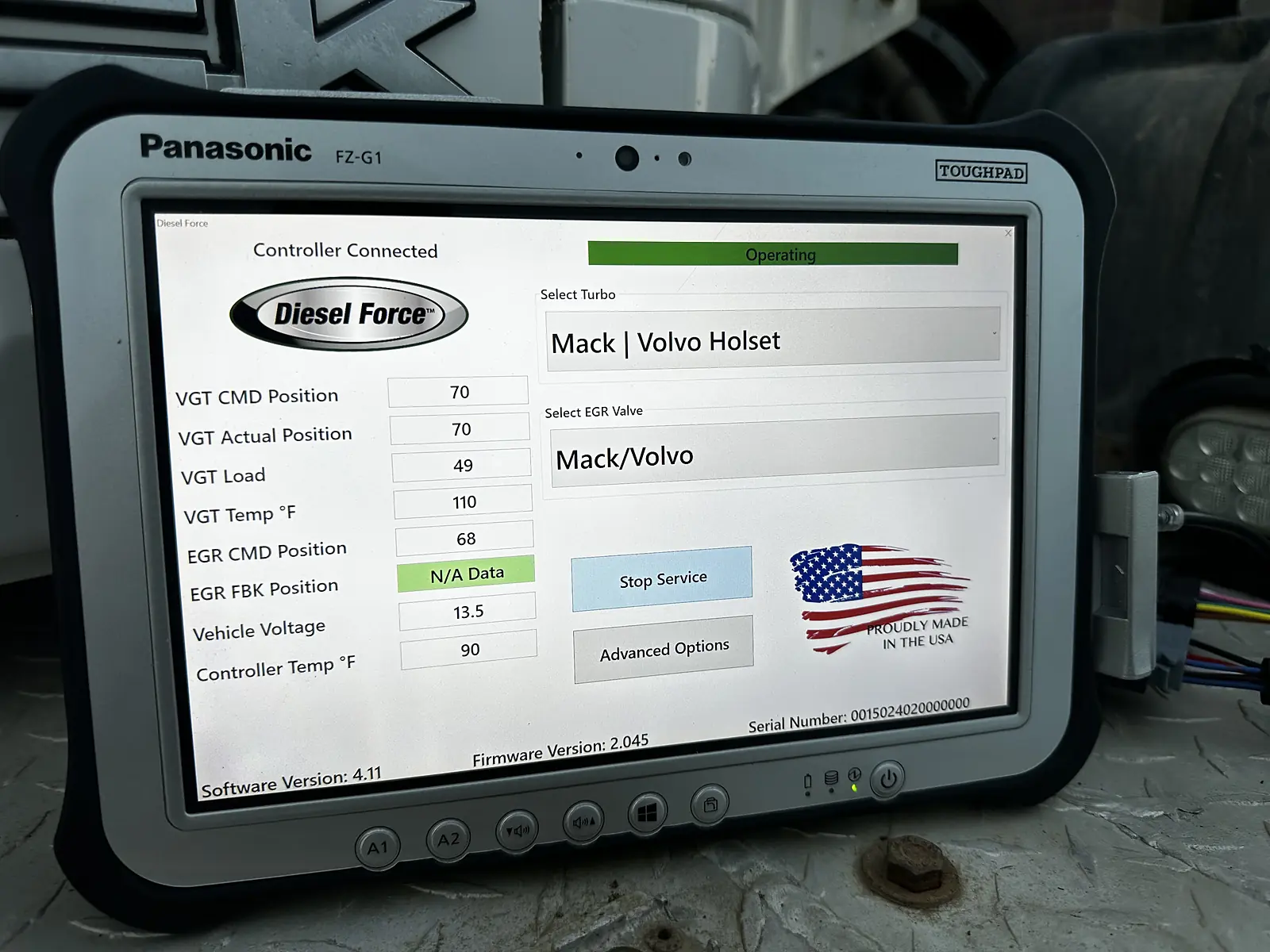
Diesel Force's Electronic Component Controller allows applicable EGR valves and VGT actuators to be cycled through their operating range during the cleaning process.
The system can also monitor information such as:
- Commanded EGR position
- Actual EGR position
- Commanded turbo position
- Actual turbo position
- Turbo actuator load
- Turbo actuator voltage
This gives the technician more information about how the component is responding while the cleaning is being performed.
Soot, Carbon and Ash Are Different Problems
This distinction matters.
A regeneration is intended to deal with combustible soot.
Carbon deposits can accumulate through the EGR, intake and turbo systems.
Ash remains in the DPF over time and cannot simply be burned away with another regen.
That means there are situations where:
- A regen makes sense
- Diesel Force cleaning makes sense
- The DPF needs to be removed and physically cleaned
- A failed component needs repair
- More than one of those steps is necessary
The right service depends on what is actually in the system and why it accumulated.
Why Does the DPF Keep Plugging?
Repeated DPF problems deserve more than repeated DPF cleaning.
Possible causes include:
- Excessive soot production
- EGR problems
- VGT problems
- Injector or combustion problems
- Excessive idle time
- Low-temperature operation
- Failed regeneration
- Differential-pressure faults
- Exhaust temperature faults
- Turbo or boost problems
- Engine derates
- Aftertreatment control problems
Cleaning the filter can restore flow.
It does not automatically correct what caused the filter to load unusually fast.
DEF & SCR Problems
SCR and DEF systems create another group of possible failures.
Mondak diagnoses problems involving:
- DEF quality
- DEF contamination
- DEF pump operation
- Supply pressure
- Dosing valves
- Crystallization
- DEF tank heating
- Level and quality sensors
- NOx sensors
- Exhaust-temperature sensors
- SCR efficiency faults
- Wiring and communication
A NOx sensor code does not automatically mean the NOx sensor is bad.
The system still needs to be tested.
Trucks, Heavy Equipment & Industrial Engines
Diesel emissions problems are not limited to highway trucks.
Mondak works on emissions-equipped engines in:
- Commercial trucks
- Construction equipment
- Agricultural equipment
- Telehandlers
- Cranes
- Rail equipment
- Oilfield equipment
- Pumps
- Generator sets
- Industrial equipment
Engine platforms include:
- Cummins
- Detroit
- Caterpillar
- Mack
- Volvo
- PACCAR
- International / Navistar
- John Deere
- DEUTZ
- Perkins
- Kubota and more
Diesel Force also supports a growing range of highway and off-highway applications through its engine-specific adapters and electronic controller connections.
OEM-Level Diagnostics
Mondak's emissions work is backed by manufacturer-specific diagnostic equipment including:
- Cummins INSITE
- Detroit DiagnosticLink
- PACCAR DAVIE4
- Volvo / Mack Premium Tech Tool
- International / Navistar diagnostic platforms
- NEXIQ communication equipment
- Additional OEM and industrial diagnostic software
Depending on the system, we can evaluate:
- Active and inactive faults
- DPF differential pressure
- Soot-load information
- Exhaust temperatures
- NOx readings
- DEF system data
- Dosing operation
- Regeneration history
- Engine derates
- Actuator tests
- CAN/J1939 communication
The fault code tells us where the controller sees a problem. Testing tells us what to repair.
Different software, communication systems and procedures
European engines can require different diagnostic software, communication systems and service procedures than the equipment most repair shops see every day.
Scania engines are used in cranes and other specialized equipment in our service area. The right software lets our technicians talk to these engines, read the faults and diagnose the emissions and engine problems instead of guessing.
Work on the equipment customers actually operate
We do not believe in telling a customer, "We do not have the software for that."
We invest in the diagnostic technology and specialized tools necessary to work on the equipment our customers actually operate.
Cleaning Can Be Preventive Too
Diesel Force is not limited to equipment that is already derated.
For appropriate applications, emissions-system cleaning can also be incorporated into preventive maintenance before carbon buildup becomes a downtime problem.
This can be particularly useful in severe-duty applications involving:
- High idle hours
- Low average speed
- Short operating cycles
- Light engine loading
- Repeated regeneration
- Equipment that rarely reaches sustained operating temperature
Diesel Force specifically developed its B1500-X around larger engines and severe-duty operating conditions that tend to produce heavy carbon accumulation.
Engine and Powertrain Repair
An emissions symptom may connect to engine management, fuel delivery or another powertrain system. Engine and drivetrain work is covered on our powertrain and drivetrain repair page.
Answers for this service
What does Mondak do when a DPF is plugged?
We determine why the DPF became loaded before simply trying to regenerate it. The problem may involve the engine, sensors, exhaust temperatures, EGR system, aftertreatment components or operating conditions.
Once the underlying issue is understood, the DPF can be cleaned or the appropriate repair performed when applicable.
When does a DPF need cleaning instead of regeneration?
Regeneration burns accumulated soot under controlled conditions. It does not solve every type of contamination or physical restriction.
A heavily loaded or contaminated filter may require professional cleaning, while other problems may require repair of the engine or aftertreatment system first.
What does DOC cleaning involve?
A Diesel Oxidation Catalyst can accumulate contamination that affects exhaust-system performance. Cleaning can restore serviceability when the component is otherwise suitable for continued use.
Why is a DEF problem not always bad DEF fluid?
DEF/SCR systems use pumps, injectors, sensors, heaters, control modules and temperature-related components. A fault in any of those systems can trigger warning messages or engine derates.
Proper diagnosis identifies which part of the system is actually failing.
What is a forced regeneration?
A forced regeneration commands the machine to perform a regeneration under controlled conditions when the equipment's diagnostic system allows it.
It is a diagnostic and service procedure, but it does not fix every DPF problem.
Clean What Can Be Cleaned. Repair What Actually Failed.
Cleaning is a tool.
So is regeneration.
So is replacing a failed component.
The value is knowing which one the equipment actually needs.
If the EGR and VGT are carbon-loaded, we can address the buildup.
If the DPF is ash-loaded, it may need to come off for proper filter cleaning.
If a sensor, doser, wiring circuit or engine problem caused the failure, that needs to be repaired too.
Tell us the truck or equipment, engine, fault codes if you have them and what the emissions system is doing. We'll start there.